
How to grow a cookbook or, a little history
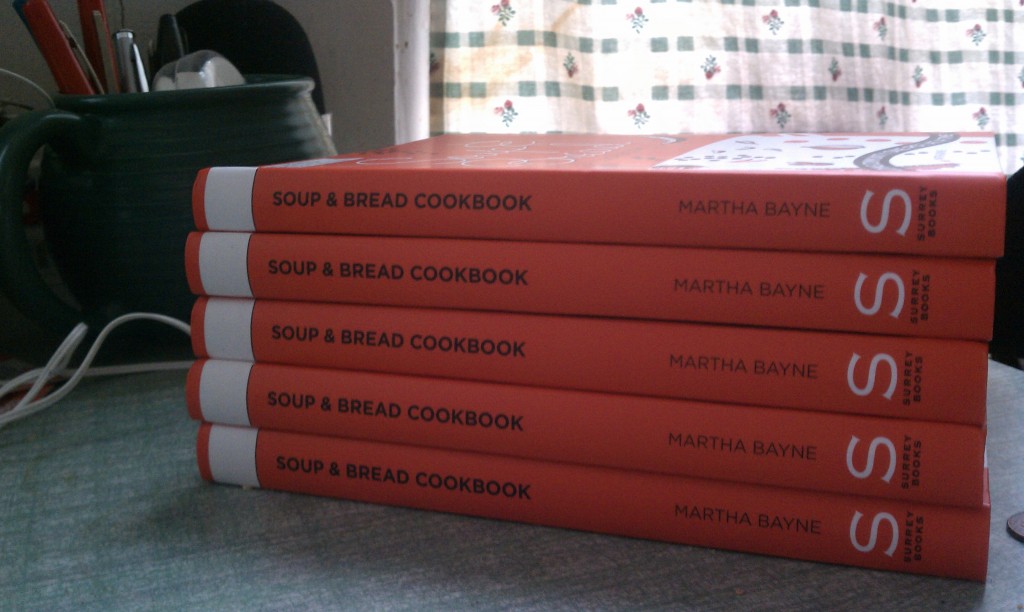
Things are busy here at Soup & Bread central. The bowls are dizzily spinning as we nail down the who, what, when on our book release party and try and corral soup cooks in four different cities (and counting) for our book tour. But as the book’s made its way out into the world (and it is, out in the world — I’ve heard from friends that they’ve seen it in stores, though I have yet to see for myself) I’ve noticed something interesting, that I should have anticipated and yet, somehow, didn’t. Namely, in some corners of the book-buying universe, this shiny new book is thought to be simply a reprint of the first Soup & Bread Cookbook.
I know — how could this have happened? I mean, it’s not like this new book shares a title, author, designer, illustrator, and general overall look and feel with the old.
Oh. Right.
Call it a pitfall of consistent branding. But, in the interest of clearing up any possible confusion, I thought I’d provide some context.
In February 2010, when Soup & Bread went to Brooklyn, the New York City media machine kicked up enough dust around our event at the Bell House that some of it landed in the eye of a very kind literary agent. “I love the recipes as well as the community aspect of this project,” she wrote. “I’d love to talk to you about the possibilities of approaching mainstream publishers with your cookbook.”
Neat!
So we did. Talk, about the genesis of Soup & Bread, and the possible paths it might wander in the future, and about how as Sheila and I had gotten out and about selling the first book, we were regularly set upon by people with soup stories of their own, and how that made me think, hm. Maybe there’s something bigger here. And that winter I produced a book proposal, and then a second proposal when the first was deemed inadequate. I revised, and revised it again, and, many long, cold months later, it was called good, and my agent started shopping it around.
And then, it was roundly rejected. “Too regional,” they said. “Not enough celebrities.”
It wasn’t surprising — if anything it was enlightening, if a little depressing. But the whole thing had been such a long shot that when it looked like it wasn’t going to pan out, I made my peace with it, though friends who listened to me whine for months about blinkered, parochial New York publishers might tell a different story.
And then Doug Seibold came calling. I have known Doug for years, ever since I commissioned a profile on him for the Reader when he was first starting up Agate Publishing in 2003. Agate purchased the cooking and hospitality imprint, Surrey Books, in 2006, and ever since he’s been busy adding a strong, thoughtful list of titles like Terra Brockman’s lovely The Seasons On Henry’s Farm to the existing backlist. I’ve known Agate associate publisher Diana Slickman for years as well, through the fringe theater scene and Theater Oobleck.
“Hey! What about us?!?,” he said.
We went to lunch. We talked. We revised the idea yet again, reining in some of the more ambitious excesses of my original proposal to craft something true to the neighborly spirit of the first book, yet still accessible to someone who’d never been to the Hideout — someone in Minneapolis, or Detroit, or Milwaukee, or Seattle. It felt right. I trust Doug — thanks to his savvy business sense Agate is one of the few thriving outfits out there as Big Publishing implodes. And as an indie publisher Doug and Agate offered us an unusual degree of creative freedom. Just ask Diana about the night we picked out our ribbon bookmark.
I spent the winter up to my neck in soup. I went to soup swaps and chili cook-offs, I went to Hull-House and I went to Detroit. With the help of a fantastically organized assistant, I wrangled together a batch of new recipes.* (Thank you Laura Fox!) Then Sheila commissioned more drawings from Paul and we hammered out a new book design. It wasn’t always easy. In the future I might recommend against trying to project manage your own book production while you’re still trying to write it. But still, it was better than working. And I can honestly say we could not be happier with the final, one-year-and-change-later manifestation of what is, in the end, a very different book.
Go here to read Chapter 2: Soup for Swapping
* Full disclosure: OK, there are a few carryovers from the first book. Some soups we just couldn’t bear to part with.
Posted: Tuesday Oct 18,2011 11:43 AM In S&B Cookbook

Recent articles
- Soup & Bread Forever14 Dec 2025
- SOUP MELTS ICE09 Nov 2025
- Soup & Bread & Thread 4/224 Mar 2025
- Soup & Bread 2025: Jan. 8 @ The Hideout26 Dec 2024
- Soup & Bread 2025, and more05 Nov 2024
Our Home Turf

Recent Articles
- Soup & Bread Forever
- SOUP MELTS ICE
- Soup & Bread & Thread 4/2
- Soup & Bread 2025: Jan. 8 @ The Hideout
- Soup & Bread 2025, and more
Search Soup & Bread
Contact
Buy the book

Feeds
Susbscribe to our awesome Blog Feed or Comments Feed